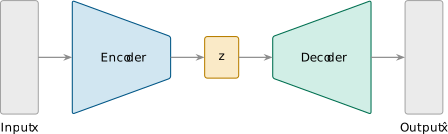
Encoder-decoder (bottleneck)
Block-level encoder-decoder 'hourglass': input block, encoder trapezoid narrowing to a latent bottleneck z, decoder trapezoid widening to an output block. Parametric sizes and labels.
This template ships an edit contract (in its meta.json) that the repo-wide using-opentikz skill reads to edit it reliably — the parameters and safe operations are listed below.
| id | encoder-decoder |
|---|---|
| type | template |
| domain | ml |
| venue | NeurIPS, ICML, CVPR, ACL |
| requires | tikz, arrows.meta, positioning |
| license | CC0-1.0 |
| author | OpenTikZ contributors |
template.tex
\documentclass[border=6pt]{standalone}

% --- packages (mirror these in template.meta.json "requires") ---
\usepackage{tikz}
\usetikzlibrary{positioning, arrows.meta}

% --- palette (canonical source: reference/color-palettes/color-palettes.md; light variant) ---
\definecolor{otblue}{HTML}{0072B2}
\definecolor{otorange}{HTML}{E69F00}
\definecolor{otteal}{HTML}{009E73}
\definecolor{otpurple}{HTML}{CC79A7}
\definecolor{otgray}{HTML}{5A5A5A}

\begin{document}
% ==== parameters (edit these) ============================================
\def\blockH{3.0}    % height of the input/output blocks (cm)
\def\latentH{1.1}   % height of the bottleneck z (cm); also the trapezoids' inner edge
\def\trapW{2.6}     % width of the encoder/decoder trapezoids (cm)
\def\blockW{1.0}    % width of the input/output blocks (cm)
\def\latentW{0.9}   % width of the bottleneck z (cm)
\def\gap{0.9}       % horizontal gap between parts (cm)
% labels
\def\inputlabel{Input $x$}
\def\encoderlabel{Encoder}
\def\latentlabel{$z$}
\def\decoderlabel{Decoder}
\def\outputlabel{Output $\hat{x}$}
% =========================================================================

\begin{tikzpicture}[
    >={Stealth[length=2.4mm]},
    ioblock/.style={draw=otgray!60, line width=0.7pt, fill=otgray!12, rounded corners=2pt},
    trap/.style={line width=0.8pt, rounded corners=1.5pt},
    latentblk/.style={draw=otorange!80!black, line width=0.8pt, fill=otorange!22, rounded corners=2pt},
    lbl/.style={font=\sffamily\small},
    flow/.style={draw=otgray!70, line width=0.9pt, ->},
  ]
  \pgfmathsetmacro{\bh}{\blockH/2}
  \pgfmathsetmacro{\lh}{\latentH/2}
  % Running left/right x edges of each part, laid out left to right.
  \pgfmathsetmacro{\xiL}{0}
  \pgfmathsetmacro{\xiR}{\xiL+\blockW}
  \pgfmathsetmacro{\xeL}{\xiR+\gap}
  \pgfmathsetmacro{\xeR}{\xeL+\trapW}
  \pgfmathsetmacro{\xzL}{\xeR+\gap}
  \pgfmathsetmacro{\xzR}{\xzL+\latentW}
  \pgfmathsetmacro{\xdL}{\xzR+\gap}
  \pgfmathsetmacro{\xdR}{\xdL+\trapW}
  \pgfmathsetmacro{\xoL}{\xdR+\gap}
  \pgfmathsetmacro{\xoR}{\xoL+\blockW}
  % Centres (for labels / trapezoid text).
  \pgfmathsetmacro{\xiC}{(\xiL+\xiR)/2}
  \pgfmathsetmacro{\xeC}{(\xeL+\xeR)/2}
  \pgfmathsetmacro{\xzC}{(\xzL+\xzR)/2}
  \pgfmathsetmacro{\xdC}{(\xdL+\xdR)/2}
  \pgfmathsetmacro{\xoC}{(\xoL+\xoR)/2}

  % --- encoder trapezoid: wide (left) -> narrow (right) ---
  \filldraw[trap, fill=otblue!18, draw=otblue!75!black]
    (\xeL,\bh) -- (\xeL,-\bh) -- (\xeR,-\lh) -- (\xeR,\lh) -- cycle;
  \node[lbl] (enc) at (\xeC,0) {\encoderlabel};
  % --- decoder trapezoid: narrow (left) -> wide (right) ---
  \filldraw[trap, fill=otteal!18, draw=otteal!70!black]
    (\xdL,\lh) -- (\xdL,-\lh) -- (\xdR,-\bh) -- (\xdR,\bh) -- cycle;
  \node[lbl] (dec) at (\xdC,0) {\decoderlabel};

  % --- input / output blocks ---
  \node[ioblock, minimum width=\blockW cm, minimum height=\blockH cm] (input)  at (\xiC,0) {};
  \node[ioblock, minimum width=\blockW cm, minimum height=\blockH cm] (output) at (\xoC,0) {};
  \node[lbl, below=3pt of input]  {\inputlabel};
  \node[lbl, below=3pt of output] {\outputlabel};

  % --- latent bottleneck ---
  \node[latentblk, minimum width=\latentW cm, minimum height=\latentH cm] (z) at (\xzC,0) {};
  \node[lbl] at (\xzC,0) {\latentlabel};

  % --- flow arrows along the centre line ---
  \draw[flow] (\xiR,0) -- (\xeL,0);
  \draw[flow] (\xeR,0) -- (\xzL,0);
  \draw[flow] (\xzR,0) -- (\xdL,0);
  \draw[flow] (\xdR,0) -- (\xoL,0);
\end{tikzpicture}
\end{document}
Edit contract — how the AI edits this template
using-opentikz skill →Parameters & safe edit operations
Parameters
\blockH | height of the input/output blocks; also each trapezoid's wide (outer) edge default 3.0 |
\latentH | height of the bottleneck z; also each trapezoid's narrow (inner) edge, so shapes meet z flush default 1.1 |
\trapW | width of the encoder/decoder trapezoids default 2.6 |
\blockW | width of the input/output blocks default 1.0 |
\latentW | width of the bottleneck z default 0.9 |
\gap | horizontal gap between parts (also the arrow length) default 0.9 |
\inputlabel | input block label (math allowed) |
\encoderlabel | encoder trapezoid label |
\latentlabel | bottleneck label drawn inside z (keep short, e.g. $z$) |
\decoderlabel | decoder trapezoid label |
\outputlabel | output block label (math allowed) |
Node naming
fixed semantic node names: (input) (enc) (z) (dec) (output); (enc)/(dec) are the centre text nodes, not the trapezoid paths
Operations
rename-part— edit the matching label macro; no layout change neededrecolor— change the palette name in the encoder/decoder \filldraw or the latentblk style; never a hex/stock colorresize— \blockH/\blockW for I/O blocks, \trapW for trapezoid length, \latentH/\latentW for the bottleneck, \gap for spacingadd-cross-attention— place a palette-colored block with positioning above (z) that (enc) feeds and that feeds (dec); connect with flow arrows; keep (enc)/(z)/(dec) intactadd-stage— insert another running edge pair after the relevant part, push later edges along by its width + \gap, draw the node and an extra flow arrow; keep every part centred on y=0
Use it
The file compiles on its own (\documentclass{standalone}).
Drop it into your project and \input it, or copy the
tikzpicture into your figure. Colours come from the shared
palette defined in the preamble — edit those named colours, not raw hex.
Graphic content is CC0 1.0 (public domain) — reuse freely, no attribution required.