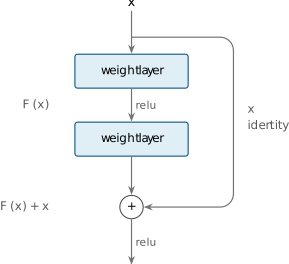
ResNet residual block
The classic ResNet residual learning building block (He et al.): a stack of weight layers forming F(x), an identity skip connection that re-enters at a summation node, and a final activation. The number of weight layers is driven by a single list at the top of the file.
This template ships an edit contract (in its meta.json) that the repo-wide using-opentikz skill reads to edit it reliably — the parameters and safe operations are listed below.
| id | resnet-block |
|---|---|
| type | template |
| domain | ml |
| venue | CVPR, NeurIPS, ICML |
| requires | tikz, arrows.meta |
| license | CC0-1.0 |
| author | OpenTikZ contributors |
template.tex
\documentclass[border=10pt]{standalone}

% --- packages (mirror these in template.meta.json "requires") ---
\usepackage{tikz}
\usetikzlibrary{arrows.meta}

% --- palette (canonical source: reference/color-palettes/color-palettes.md; light variant) ---
\definecolor{otblue}{HTML}{0072B2}
\definecolor{otorange}{HTML}{E69F00}
\definecolor{otteal}{HTML}{009E73}
\definecolor{otpurple}{HTML}{CC79A7}
\definecolor{otgray}{HTML}{5A5A5A}

\begin{document}
% ==== parameters (edit these) ============================================
% Labels of the weight-layer boxes in the residual branch, top to bottom.
% The number of entries IS the number of stacked layers (classic block = 2).
\def\branchlabels{weight layer,weight layer}
\def\actlabel{relu}                              % activation between layers and after the sum
\def\inputlabel{$\mathbf{x}$}                    % top input
\def\residuallabel{$\mathcal{F}(\mathbf{x})$}    % side label for the residual branch
\def\outputlabel{$\mathcal{F}(\mathbf{x})+\mathbf{x}$} % side label at the sum
\def\skiplabel{$\mathbf{x}$}                      % identity / skip-path label (upper)
\def\identitylabel{identity}                      % identity / skip-path label (lower)
\def\blocksep{1.8}   % vertical centre-to-centre distance between stages (cm)
\def\blockw{3.0}     % weight-layer box width (cm)
\def\blockh{0.9}     % weight-layer box height (cm)
\def\skipbow{2.7}    % how far right the identity skip connection bows out (cm)
% =========================================================================

\begin{tikzpicture}[
    >={Stealth[length=2.4mm]},
    wlayer/.style={
      draw=otblue!70!black, fill=otblue!12, rounded corners=2pt,
      line width=0.8pt, align=center, font=\sffamily\small,
      minimum width=\blockw cm, minimum height=\blockh cm,
    },
    addop/.style={
      circle, draw=otgray!85!black, line width=0.8pt,
      inner sep=1.4pt, minimum size=0.62cm, font=\small,
    },
    flow/.style={draw=otgray!85, line width=0.9pt, ->},
    skip/.style={draw=otgray!85, line width=0.9pt, ->, rounded corners=10pt},
    actlbl/.style={font=\sffamily\footnotesize, text=otgray, inner sep=2.5pt},
    sidelbl/.style={font=\small, text=otgray},
  ]

  % --- input ---
  \node[font=\bfseries] (xlabel) at (0,0) {\inputlabel};

  % --- residual branch: stack the weight-layer boxes, relu between them ---
  \foreach \lab [count=\i, remember=\i as \previ (initially 0)] in \branchlabels {
    \pgfmathsetmacro{\yy}{-\i*\blocksep}
    \node[wlayer] (wl\i) at (0,\yy) {\lab};
    \ifnum\i=1
      \draw[flow] (xlabel) -- (wl\i);
    \else
      \draw[flow] (wl\previ) -- node[actlbl, right] {\actlabel} (wl\i);
    \fi
    \global\let\nlayers\i
  }

  % --- summation node and output ---
  \pgfmathsetmacro{\sumy}{-(\nlayers+1)*\blocksep}
  \node[addop] (sum) at (0,\sumy) {$+$};
  \draw[flow] (wl\nlayers) -- (sum);
  \pgfmathsetmacro{\outy}{\sumy-0.85*\blocksep}
  \coordinate (out) at (0,\outy);
  \draw[flow] (sum) -- node[actlbl, right] {\actlabel} (out);

  % --- identity skip connection: branches off the input line, bows right,
  %     and re-enters the sum from the right ---
  \coordinate (branch)    at (0,{-0.5*\blocksep});
  \coordinate (skipright) at (\skipbow,{-0.5*\blocksep});
  \draw[skip] (branch) -- (skipright) -- (skipright |- sum) -- (sum);

  % --- side labels ---
  \pgfmathsetmacro{\leftx}{-\blockw/2-0.55}
  \pgfmathsetmacro{\midy}{-(1+\nlayers)/2*\blocksep}
  \node[sidelbl, anchor=east] at (\leftx,\midy)  {\residuallabel};
  \node[sidelbl, anchor=east] at (\leftx,\sumy)  {\outputlabel};

  \pgfmathsetmacro{\skmy}{(-0.5*\blocksep+\sumy)/2}
  \node[sidelbl, anchor=west] at (\skipbow+0.25,\skmy+0.32) {\skiplabel};
  \node[sidelbl, anchor=west] at (\skipbow+0.25,\skmy-0.10) {\identitylabel};

\end{tikzpicture}
\end{document}
Edit contract — how the AI edits this template
using-opentikz skill →Parameters & safe edit operations
Parameters
\branchlabels | labels of the weight-layer boxes in the residual branch, top to bottom; the number of entries is the number of stacked layers default {weight layer,weight layer} |
\actlabel | activation label shown between consecutive weight layers and after the summation default relu |
\inputlabel | top input label default $\mathbf{x}$ |
\residuallabel | side label naming the residual branch default $\mathcal{F}(\mathbf{x})$ |
\outputlabel | side label at the summation node default $\mathcal{F}(\mathbf{x})+\mathbf{x}$ |
\skiplabel | upper label on the identity skip path default $\mathbf{x}$ |
\identitylabel | lower label on the identity skip path default identity |
\blocksep | vertical centre-to-centre distance between stages default 1.8 |
\blockw | weight-layer box width default 3.0 |
\blockh | weight-layer box height default 0.9 |
\skipbow | how far right the identity skip connection bows out default 2.7 |
Node naming
wl<i> for weight-layer boxes (1-based, top to bottom, e.g. wl1, wl2); xlabel for the input; sum for the addition node; out for the output coordinate
Operations
add-weight-layer— append a label to \branchlabels (the relu between layers and the wl<i> naming follow automatically); insert mid-branch by adding at the desired position in the listremove-weight-layer— delete one entry from \branchlabels (keep at least one)relabel-activation— change \actlabel (e.g. relu -> GELU); it applies to every inter-layer arrow and the post-sum arrowrecolor— change the palette color name used by the wlayer style (e.g. otblue -> otteal) and/or otgray in flow/skip/addop; never a hex or stock colorresize-spacing— \blockw and \blockh size the boxes; \blocksep sets vertical spacing; \skipbow controls how far the identity path bows right
Use it
The file compiles on its own (\documentclass{standalone}).
Drop it into your project and \input it, or copy the
tikzpicture into your figure. Colours come from the shared
palette defined in the preamble — edit those named colours, not raw hex.
Graphic content is CC0 1.0 (public domain) — reuse freely, no attribution required.